

Shelter Building - Free Risk Assessment Template PDF
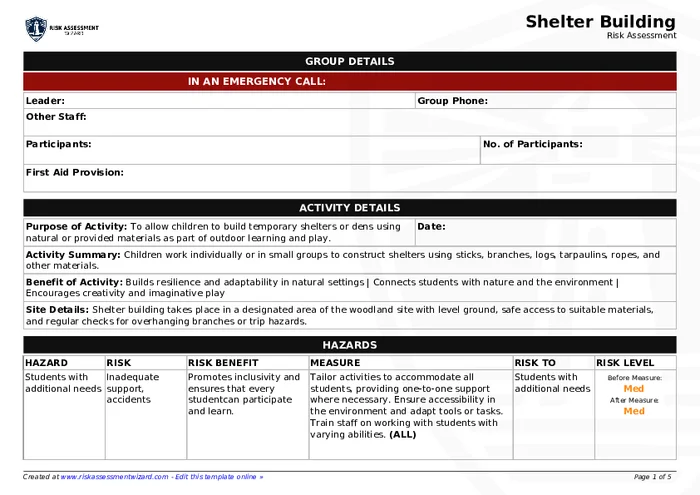
This free Shelter Building risk assessment template is designed for forest schools settings. It outlines typical hazards and suggests control measures, helping you tailor the document to your organization. Use it as a starting point, customise in our online wizard and download a professional PDF in moments.
Edit Using WizardView Template PDF
Activity Summary
Children work individually or in small groups to construct shelters using sticks, branches, logs, tarpaulins, ropes, and other materials.
Purpose of Activity
To allow children to build temporary shelters or dens using natural or provided materials as part of outdoor learning and play.
Benefits of Activity
- Builds resilience and adaptability in natural settings
- Connects students with nature and the environment
- Encourages creativity and imaginative play
- Teaches respect for nature and weather safety protocols.
- Encourages self-management and understanding of personal health needs.
- Encourages teamwork, problem-solving, and physical development.
- Builds confidence, balance, and risk management in climbing activities.
- Teaches preparation for cold environments and personal safety.
- Teaches self-care and builds resilience in minor accidents.
- Enhances spatial awareness and navigation skills.
- Enhances environmental awareness and promotes safety skills.
- Ensures a safer, more controlled environment, allowing for closer supervision and support.
- Promotes self-care and teaches students the importance of dressing for outdoor conditions.
- Develops fine motor skills and creativity through hands-on activities.
- Promotes botanical knowledge and safe foraging practices.
- Reinforces discipline and ensures everyone is on the same page for a safer experience.
- Promotes balance, coordination, and cautious movement.
- Promotes inclusivity and ensures that every studentcan participate and learn.
- Fosters creativity, engineering skills, and teamwork.
Hazards and Control Measures
| Hazard | Control Measures |
|---|---|
| Adverse weather (storms, lightning) | Regularly check weather forecasts and have a plan for shelter in case of storms. Stop all outdoor activities immediately if lightning is detected within 30 miles. Use indoor spaces or pre-set shelters if necessary. |
| Allergies (plants, insect stings) | Identify students with allergies and avoid known triggers. Have allergy medication on hand, including epinephrine for severe reactions. Educate about identifying dangerous plants like nettles or poison ivy. |
| Carrying heavy objects (logs, stones) | Teach correct lifting techniques and supervise closely when students are handling heavy materials. Provide assistance for larger objects. |
| Climbing trees | Set clear boundaries on which trees are safe to climb and supervise at all times. Limit the height to which students can climb based on age and ability. |
| Cold weather | Ensure students wear appropriate clothing and check for signs of cold exposure regularly. Provide shelters and warm drinks if needed. |
| Cuts and scrapes from rough terrain | Have first aid kits available to treat minor injuries immediately. Instruct students on how to avoid rough areas and use protective gloves when necessary. |
| Eye-level branches | Regularly cut back any branches at eye level in frequently used areas. Educate students on safely navigating through wooded areas. |
| Falling branches | Conduct regular site checks for unstable or fallen branches. Instruct students to avoid playing near potentially dangerous trees. students learn to identify and assess their environment. |
| Inadequate adult-to-student ratios | Ensure appropriate ratios are maintained for supervision. Pre-plan sessions based on group size, ability and age and adjust staff accordingly. |
| Inadequate clothing | Remind students to wear weather-appropriate clothing and footwear. Keep spare waterproofs, jackets, and hats available. Encourage parents to check the forecast and send students in layers for warmth. |
| Injury from natural materials (sticks, stones) | Supervise and educate on the correct handling of natural materials. Ensure protective clothing like gloves when necessary. Regularly inspect the area for sharp objects. |
| Poisonous plants and fungi | Conduct site surveys to identify and remove or mark poisonous plants or fungi. Teach students about safe plant identification and the importance of not eating unknown plants. |
| Poor group management (safety briefing) | Begin every session with a thorough safety briefing, outlining the rules and boundaries for the day's activities. Emphasize the importance of listening, staying within designated areas, and following instructions. |
| Slips, trips, and falls | Ensure pathways are clear and mark hazardous areas. Educate students on safe movement over uneven terrain. Supervise closely, especially near wet or steep areas. |
| Students with additional needs | Tailor activities to accommodate all students, providing one-to-one support where necessary. Ensure accessibility in the environment and adapt tools or tasks. Train staff on working with students with varying abilities. |
| Using dens and shelters | Supervise the building process to ensure stability. Teach students safe den-building techniques and inspect shelters before use. |
Edit Using WizardView Template PDF
Related Risk Assessment Template Downloads
- Den Building
- Fire Lighting
- Forest School Tool Use
- Generic Forest School Site
- Group Campfires
- Nature Walk Through Woodland
- Open Fire Cooking
- Shelter Building
FAQ
How do I use this template?
Click “Edit Using Wizard” to customise the assessment for your organization, then download a PDF.
Can I edit the hazards and controls?
Yes, all sections can be adjusted in the wizard before exporting your final document.