

Forest School Tool Use - Free Risk Assessment Template PDF
This free Forest School Tool Use risk assessment template is designed for forest schools settings. It outlines typical hazards and suggests control measures, helping you tailor the document to your organization. Use it as a starting point, customise in our online wizard and download a professional PDF in moments.
Edit Using WizardView Template PDF
Activity Summary
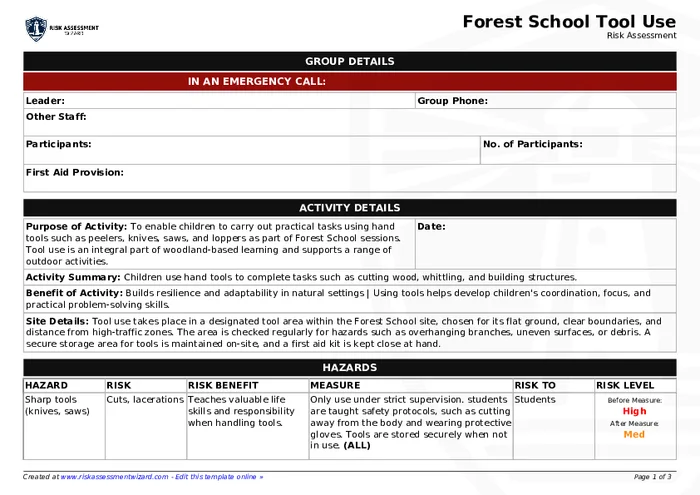
Children use hand tools to complete tasks such as cutting wood, whittling, and building structures.
Purpose of Activity
To enable children to carry out practical tasks using hand tools such as peelers, knives, saws, and loppers as part of Forest School sessions. Tool use is an integral part of woodland-based learning and supports a range of outdoor activities.
Benefits of Activity
- Builds resilience and adaptability in natural settings
- Using tools helps develop children's coordination, focus, and practical problem-solving skills.
- Teaches practical skills and responsibility in a controlled, supervised environment.
- Teaches valuable life skills and responsibility when handling tools.
- Reinforces discipline and ensures everyone is on the same page for a safer experience.
- Promotes inclusivity and ensures that every studentcan participate and learn.
- Promotes self-care and teaches students the importance of dressing for outdoor conditions.
- Ensures activities are led by knowledgeable and capable individuals, enhancing safety and learning outcomes.
- Promotes physical activity and an understanding of terrain challenges.
- Carrying tools allows children to develop responsibility, coordination, and an understanding of safe handling practices essential for practical outdoor tasks.
- Using tools provides valuable hands-on learning and skill development.
Hazards and Control Measures
| Hazard | Control Measures |
|---|---|
| Incorrect use of tools | Provide a comprehensive tool-use demonstration before any activity. Closely supervise all tool use, ensuring each studentunderstands how to handle the tool safely and correctly. |
| Sharp tools (knives, saws) | Only use under strict supervision. students are taught safety protocols, such as cutting away from the body and wearing protective gloves. Tools are stored securely when not in use. |
| Poor group management (safety briefing) | Begin every session with a thorough safety briefing, outlining the rules and boundaries for the day's activities. Emphasize the importance of listening, staying within designated areas, and following instructions. |
| Students with additional needs | Tailor activities to accommodate all students, providing one-to-one support where necessary. Ensure accessibility in the environment and adapt tools or tasks. Train staff on working with students with varying abilities. |
| Inadequate clothing | Remind students to wear weather-appropriate clothing and footwear. Keep spare waterproofs, jackets, and hats available. Encourage parents to check the forecast and send students in layers for warmth. |
| Leader experience/qualifications | Ensure all leaders are properly trained and hold relevant Forest School qualifications. Regularly update skills through professional development and first aid training. |
| Running on uneven ground | Restrict running to appropriate safe areas. Educate on the dangers of tripping over tree roots and other natural obstacles. Supervise running games closely. |
| Carrying tools | Tools carried blade-down or in sheath. Children taught not to run while carrying tools. Only carry one tool at a time. |
| Faulty or damaged tools | All tools checked before and after each session. Damaged tools removed immediately and repaired before their next use. Tools stored securely when not in use. |
Edit Using WizardView Template PDF
Related Risk Assessment Template Downloads
- Den Building
- Fire Lighting
- Forest School Tool Use
- Generic Forest School Site
- Group Campfires
- Nature Walk Through Woodland
- Open Fire Cooking
- Shelter Building
FAQ
How do I use this template?
Click “Edit Using Wizard” to customise the assessment for your organization, then download a PDF.
Can I edit the hazards and controls?
Yes, all sections can be adjusted in the wizard before exporting your final document.