

Group Campfires - Free Risk Assessment Template PDF
This free Group Campfires risk assessment template is designed for forest schools settings. It outlines typical hazards and suggests control measures, helping you tailor the document to your organization. Use it as a starting point, customise in our online wizard and download a professional PDF in moments.
Edit Using WizardView Template PDF
Activity Summary
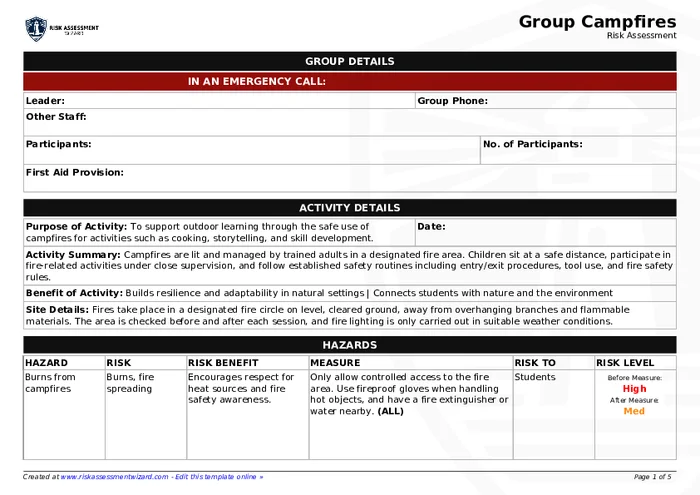
Campfires are lit and managed by trained adults in a designated fire area. Children sit at a safe distance, participate in fire-related activities under close supervision, and follow established safety routines including entry/exit procedures, tool use, and fire safety rules.
Purpose of Activity
To support outdoor learning through the safe use of campfires for activities such as cooking, storytelling, and skill development.
Benefits of Activity
- Builds resilience and adaptability in natural settings
- Connects students with nature and the environment
- Encourages respect for heat sources and fire safety awareness.
- Promotes situational caution and reinforces the importance of safe, stable seating arrangements.
- Teaches fire safety awareness and response techniques.
- Builds awareness of material properties and safe clothing choices.
- Teaches adaptability to changing conditions and encourages proactive safety decisions.
- Teaches boundary respect and reinforces safe spatial awareness.
- Teaches the importance of accountability and vigilance for shared safety.
- Promotes environmental safety and reinforces the importance of preemptive risk management.
- Reinforces patience and respect for residual heat hazards.
- Offers practical skill-building within a supervised setting.
- Instills accountability among supervisors and ensures safe management of the entire group.
- Encourages vigilance about footing, fostering careful movement near hazards.
- Promotes inclusivity, enhancing empathy and awareness while ensuring everyone can participate safely.
- Builds trust and confidence in leadership, providing students with reliable guidance and mentorship.
- Provides peace of mind and preparedness, ensuring swift response in case of an emergency.
- Reduces the chance of accidents, promoting orderly interaction and respect for fire boundaries.
- Builds understanding of environmental safety and responsible resource use when cooking outdoors.
Hazards and Control Measures
| Hazard | Control Measures |
|---|---|
| Burns from campfires | Only allow controlled access to the fire area. Use fireproof gloves when handling hot objects, and have a fire extinguisher or water nearby. |
| Burns from unstable seating | Inspect seating for stability before allowing students to sit. Space seating at a safe distance from the fire to prevent falls and avoid overcrowding. Have backup seating options available if needed. |
| Clothing catching fire | Wear non-flammable clothing and secure loose items like scarves. Keep a fire blanket and water bucket close. Instruct students on “Stop, Drop, and Roll” in case of fire and emphasize safe postures and spacing around the flames for added protection. |
| Contact with spitting embers | Only use dry, seasoned wood to prevent spitting embers, and avoid sap-heavy woods like pine. Ensure students stand back from the fire and wear clothing made from natural fibers, which are less likely to catch fire from embers. |
| Adverse weather | Monitor weather conditions and avoid lighting fires in extreme wind, rain, or dry conditions. Have a backup plan for inclement weather, such as postponing or using alternative sheltered locations if safe. |
| Falling into the fire | Define a fire circle using stones or rope to mark safe distances, and instruct students to avoid crossing it. Remind them to walk carefully around the area. Constant supervision will ensure safe behavior and adherence to the established boundaries. |
| Fire left unattended | No fire is left without adult supervision. Assign a fire watch rotation to monitor flames, ensuring no time gaps. Douse all flames completely when activity concludes. |
| Fire spreading to nearby vegetation | Clear a 3-meter area of vegetation around the fire site, and douse flames if any spread occurs. Always keep a water bucket nearby and ensure that students know the immediate response plan if fire spreads. |
| Hot ash contact after fire is extinguished | Douse all embers and ashes with water before allowing students near the fire pit. Clearly mark areas with residual heat, and remind students of potential hidden hot spots after cooking. |
| Improper lighting techniques | Teach fire lighting basics with a demonstration, allowing only adults to light larger fires. Emphasize safe lighting techniques, body positioning, and the need for attentiveness. Students may assist only with guidance and supervision. |
| Inadequate supervision | Set clear adult-to-student ratios based on group size and age. Assign roles to adults to ensure all areas are covered, especially fire and cooking zones, and maintain constant supervision. |
| Tripping near the fire | Remove rocks, roots, and any obstacles within a 2-meter radius of the fire. Create a clear path around the fire for movement and brief students on moving cautiously in this area to prevent accidental trips or falls. |
| Students with additional needs | Identify and assess any additional needs in advance, providing adapted equipment and extra supervision where needed. Ensure that all students receive equal safety support and feel included in all activities. |
| Leader experience/qualifications | Ensure that leaders have experience with outdoor cooking and fire safety, and where possible, relevant certifications. Leaders should be trained in fire protocols and basic first aid for emergency preparedness. |
| Insufficient emergency equipment | Keep fire extinguishing materials like water buckets, fire blankets, and a first aid kit within reach. Brief students and staff on their locations and ensure emergency supplies are checked and accessible before the activity starts. |
| Overcrowded fire | Limit the number of students near the fire area. Establish zones and stagger cooking times to prevent overcrowding. Set clear guidelines for who can approach the fire at any given time to ensure sufficient space and safe movement. |
| Use of inappropriate materials as fuel | Only use seasoned wood approved for burning, avoiding materials like plastic or treated wood that release harmful fumes. Brief students on safe fuel options and restrict access to prohibited materials. |
Edit Using WizardView Template PDF
Related Risk Assessment Template Downloads
- Den Building
- Fire Lighting
- Forest School Tool Use
- Generic Forest School Site
- Group Campfires
- Nature Walk Through Woodland
- Open Fire Cooking
- Shelter Building
FAQ
How do I use this template?
Click “Edit Using Wizard” to customise the assessment for your organization, then download a PDF.
Can I edit the hazards and controls?
Yes, all sections can be adjusted in the wizard before exporting your final document.