Create clear, professional risk assessments in minutes. List hazards, set measures and assign responsibilities, then download a clean PDF branded with your organisation.
Get Started
Create a Risk Assessment
1
Hiking Risk Assessment
Create a professional, comprehensive risk assessment for hiking in youth group settings. Tailor hazards and measures to your needs and download a professional PDF. Add your own branding.
Begin straight away; create a free account later if you want to save.
What this covers.
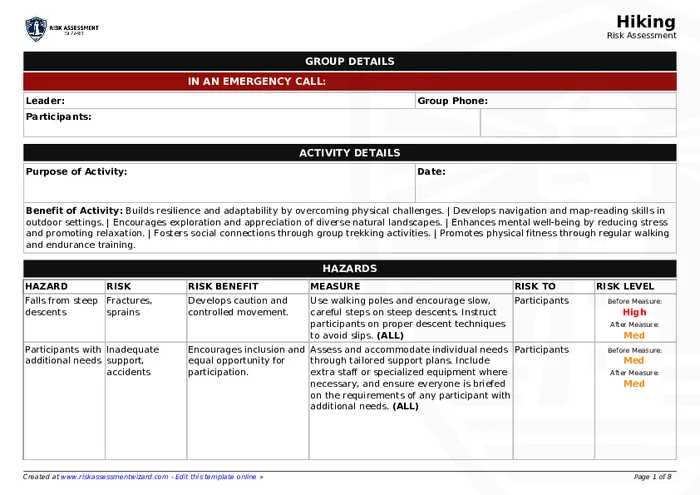
This template focuses on typical risks and controls for hiking in youth group settings. You can add, remove or adapt items to match your context.
Potential benefits
Encourages exploration and appreciation of diverse natural landscapes.
Enhances mental well-being by reducing stress and promoting relaxation.
Builds resilience and adaptability by overcoming physical challenges.
Fosters social connections through group trekking activities.
Promotes physical fitness through regular walking and endurance training.
Typical hazards & measures
Injury from carrying heavy backpacks
— Teach proper backpack packing techniques and ensure packs are fitted correctly with weight distributed evenly. Limit pack weight to 15-20% of body weight for young hikers.
Falls from steep descents
— Use walking poles and encourage slow, careful steps on steep descents. Instruct participants on proper descent techniques to avoid slips.
Adverse or extreme weather conditions
— Check detailed weather forecasts and monitor conditions prior to and throughout the hike. Adapt routes and schedules to avoid hazardous conditions such as storms, high winds, or extreme heat. Ensure participants have appropriate layered, waterproof, and breathable clothing, sun protection, and sufficient water. Schedule hydration and shade breaks in hot weather and warming breaks in cold conditions. Carry emergency shelter, thermal blankets, and first aid equipment. Avoid exposed ridges, open areas, and flood-prone zones during storms, and have clear contingency plans for shelter or early route termination.
Head injury from low branches
— Instruct participants to stay alert to overhanging branches, particularly in dense wooded areas. Clear branches from the path when possible.
Snake bites
— Educate participants about local snakes and how to avoid them. Wear long pants and boots, and use hiking poles to check undergrowth. Carry a snakebite kit if relevant to the area.
How to use this template
Click Create Risk Assessment: Hiking to begin immediately.
Review suggested hazards and measures, then tailor as needed.
Download your PDF. Create a free account if you want to save.
To provide the best experiences, we use technologies like cookies to store and/or access device information. Consenting to these technologies will allow us to process data such as browsing behavior or unique IDs on this site. Not consenting or withdrawing consent, may adversely affect certain features and functions.
Functional
Always active
The technical storage or access is strictly necessary for the legitimate purpose of enabling the use of a specific service explicitly requested by the subscriber or user, or for the sole purpose of carrying out the transmission of a communication over an electronic communications network.
Preferences
The technical storage or access is necessary for the legitimate purpose of storing preferences that are not requested by the subscriber or user.
Statistics
The technical storage or access that is used exclusively for statistical purposes.The technical storage or access that is used exclusively for anonymous statistical purposes. Without a subpoena, voluntary compliance on the part of your Internet Service Provider, or additional records from a third party, information stored or retrieved for this purpose alone cannot usually be used to identify you.
Marketing
The technical storage or access is required to create user profiles to send advertising, or to track the user on a website or across several websites for similar marketing purposes.