Create clear, professional risk assessments in minutes. List hazards, set measures and assign responsibilities, then download a clean PDF branded with your organisation.
Get Started
Create a Risk Assessment
1
Walking Risk Assessment
Create a professional, comprehensive risk assessment for walking in school & education settings. Tailor hazards and measures to your needs and download a professional PDF. Add your own branding.
Begin straight away; create a free account later if you want to save.
What this covers.
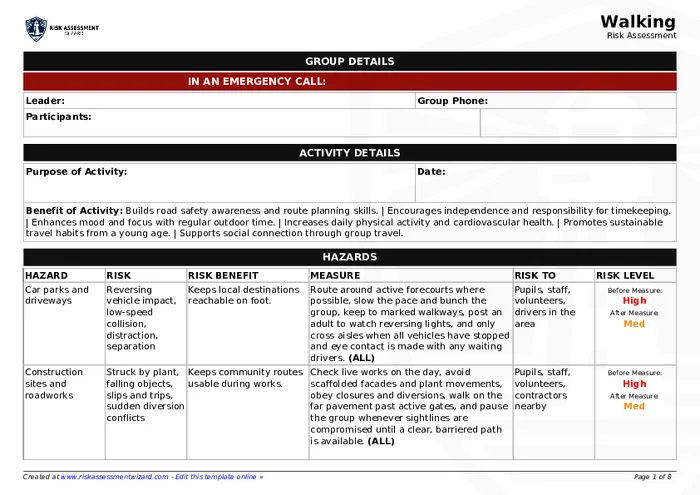
This template focuses on typical risks and controls for walking in school & education settings. You can add, remove or adapt items to match your context.
Potential benefits
Promotes sustainable travel habits from a young age.
Builds road safety awareness and route planning skills.
Encourages independence and responsibility for timekeeping.
Enhances mood and focus with regular outdoor time.
Supports social connection through group travel.
Typical hazards & measures
Hydration
— Require each pupil to start with a filled bottle, schedule defined water stops away from kerbs and traffic, moderate pace on exposed sections, provide shaded pauses, monitor for headache, dizziness or cramps, carry spare water for refills, and note any welfare checks in the trip log.
Toilet access
— Map reliable toilets before departure, brief supervised entry/exit and a buddy system, carry small change and hygiene supplies, build planned stops into the timetable, permit urgent detours with an adult, and re-count at the door so continence needs are met without losing pupils.
Low light and visibility
— Prefer daylight; if dusk is possible, increase adult spacing to cover sightlines, add high-visibility for leaders, carry torches for decision points, avoid unlit cut-throughs, and postpone when lux levels are too low for safe group control or hazard detection.
Construction sites and roadworks
— Check live works on the day, avoid scaffolded facades and plant movements, obey closures and diversions, walk on the far pavement past active gates, and pause the group whenever sightlines are compromised until a clear, barriered path is available.
Pollen and seasonal allergies
— Check regional pollen forecasts before departure, brief families on pre-medication plans, favour hard-surface routes when counts are high, schedule shaded rest points, and support mask/eyewear for symptomatic pupils with quick access to water and tissues.
How to use this template
Click Create Risk Assessment: Walking to begin immediately.
Review suggested hazards and measures, then tailor as needed.
Download your PDF. Create a free account if you want to save.
To provide the best experiences, we use technologies like cookies to store and/or access device information. Consenting to these technologies will allow us to process data such as browsing behavior or unique IDs on this site. Not consenting or withdrawing consent, may adversely affect certain features and functions.
Functional
Always active
The technical storage or access is strictly necessary for the legitimate purpose of enabling the use of a specific service explicitly requested by the subscriber or user, or for the sole purpose of carrying out the transmission of a communication over an electronic communications network.
Preferences
The technical storage or access is necessary for the legitimate purpose of storing preferences that are not requested by the subscriber or user.
Statistics
The technical storage or access that is used exclusively for statistical purposes.The technical storage or access that is used exclusively for anonymous statistical purposes. Without a subpoena, voluntary compliance on the part of your Internet Service Provider, or additional records from a third party, information stored or retrieved for this purpose alone cannot usually be used to identify you.
Marketing
The technical storage or access is required to create user profiles to send advertising, or to track the user on a website or across several websites for similar marketing purposes.