

Kayaking on a Lake - Free Risk Assessment Template PDF
This free Kayaking on a Lake risk assessment template is designed for youth group settings. It outlines typical hazards and suggests control measures, helping you tailor the document to your organization. Use it as a starting point, customise in our online wizard and download a professional PDF in moments.
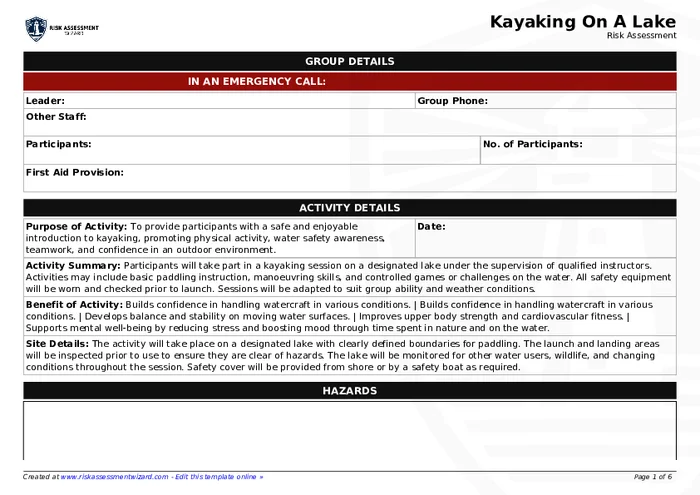
Activity Summary
Participants will take part in a kayaking session on a designated lake under the supervision of qualified instructors. Activities may include basic paddling instruction, manoeuvring skills, and controlled games or challenges on the water. All safety equipment will be worn and checked prior to launch. Sessions will be adapted to suit group ability and weather conditions.
Purpose of Activity
To provide participants with a safe and enjoyable introduction to kayaking, promoting physical activity, water safety awareness, teamwork, and confidence in an outdoor environment.
Benefits of Activity
- Builds confidence in handling watercraft in various conditions.
- Builds confidence in handling watercraft in various conditions.
- Develops balance and stability on moving water surfaces.
- Improves upper body strength and cardiovascular fitness.
- Supports mental well-being by reducing stress and boosting mood through time spent in nature and on the water.
- Builds confidence in self-recovery and resilience in challenging situations.
- Builds awareness of environmental conditions, improves preparation skills, and develops resilience in challenging weather.
- Promotes teamwork, spatial awareness, and respect for the environment and other water users.
- Builds navigational skill and caution in natural settings.
- Encourages responsibility, preparedness, and correct use of equipment, reinforcing personal safety awareness.
- Promotes adaptability and respect for natural water conditions.
- Provides a safer learning environment and reduces the likelihood of accidents.
- Reinforces the importance of preparedness and proper gear.
- Builds confidence and promotes steady skill development.
- Builds proper technique and avoids injury.
- Promotes adaptability and awareness of weather conditions.
- Encourages inclusivity and preparedness for all participants.
- Promotes inclusivity and provides opportunities for all participants.
- Protects participants’ well-being and ensures a safe environment for all.
- Develops navigation skills, cooperation, and responsibility for peers while promoting group cohesion.
- Teaches careful movement in wet environments.
- Promotes healthy physical activity and injury prevention.
- Develops adaptability in changing environments.
- Encourages proactive sun safety habits.
- Teaches environmental awareness.
Hazards and Control Measures
| Hazard | Control Measures |
|---|---|
| Capsizing | Conduct thorough capsize drills prior to water entry. Ensure all participants are familiar with recovery techniques and instructors are ready to assist immediately. Review conditions before launching. |
| Cold exposure (air & water) | Educate participants on cold water shock symptoms and hypothermia signs. Ensure appropriate clothing such as wetsuits, thermal layers, and windproof jackets is worn. Limit unnecessary immersion in cold water, provide regular warm-up breaks, and have a rescue plan for quick recovery. Keep emergency blankets and hot drinks available. |
| Collisions with boats, paddles, or obstacles | All participants must wear helmets. Brief on safe spacing, paddle awareness, and collision avoidance strategies. Select routes with minimal obstacles for beginners and instruct on navigating shared waters. Instructors should monitor positioning, maintain group control, and adjust course to avoid hazards or other water users. |
| Entrapment by obstacles (e.g., branches) | Brief participants on avoiding low-hanging branches and submerged obstacles. Instructors should scout the route beforehand and guide participants away from risky areas. |
| Equipment faults or misuse | Inspect all kayaks, paddles, buoyancy aids, and other safety gear before each session. Ensure correct fitting and adjustment of buoyancy aids for every participant. Keep spare equipment on-site and repair kits available for immediate fixes. Instructors should check equipment regularly during the session and replace any items showing signs of wear or damage. |
| Flooding (high water levels) | Check water levels and flow rates before the session. Avoid rivers and lakes prone to flooding after heavy rains. Instructors should be prepared to cancel the session if conditions are unsafe. |
| Inadequate supervision | Maintain appropriate ratios of instructors to participants, with a higher ratio for less experienced or younger participants. Instructors should maintain visual contact at all times and be positioned to respond quickly to any incidents. |
| Inappropriate clothing | Check that participants wear proper water sports gear, including shoes that grip and protective clothing. No loose, heavy clothing that can trap water. Have spare gear available in case participants are improperly dressed. |
| Inexperienced participants | Start all beginners with basic instruction on paddling, safety, and self-rescue. Offer progressive training to build confidence and skill. Monitor each participant's progression to ensure they aren't overextending themselves. |
| Launching kayaks incorrectly | Supervise participants during kayak launch and demonstrate correct techniques. Ensure kayaks are launched away from obstacles, and instructors should assist with stabilizing the kayaks during entry. |
| Lightning during the session | Monitor weather forecasts for signs of thunderstorms. If lightning is visible, immediately end the session and bring participants to shore. Establish an emergency shelter location prior to the activity. |
| Medical conditions (e.g., asthma) | Collect medical information from participants beforehand and carry necessary medication, such as inhalers. Instructors should be trained to recognize symptoms and respond quickly to medical needs during the session. |
| Participants with additional needs | Conduct individual assessments for participants with additional needs and ensure equipment and activity modifications are in place. Instructors should be trained in adaptive techniques and provide extra supervision as needed. |
| Safeguarding | All instructors and staff must be trained in safeguarding protocols, with background checks completed. Establish a clear reporting system for any concerns. Maintain appropriate adult-to-child ratios and ensure privacy in changing and restroom areas. |
| Separation from group | Maintain close supervision and clear communication at all times. Use a buddy system, set clear boundaries, and conduct regular headcounts. Instructors should position themselves to maintain visual and auditory contact with all participants and have a plan for regrouping quickly if separation occurs. |
| Slips, trips, and falls on wet surfaces | Ensure all launch and landing areas are clear of obstructions and participants wear non-slip footwear. Supervise entry and exit procedures and provide assistance where necessary to avoid slipping. |
| Strain injuries (from paddling) | Provide proper warm-up exercises and instruction on correct paddling techniques. Encourage regular breaks during long sessions to prevent overexertion and monitor participants for signs of fatigue. |
| Sudden weather changes | Check weather forecasts before starting and remain aware of changing conditions. If necessary, terminate the session and head to shore if weather deteriorates. Always have a contingency plan. |
| Sunburn | Ensure participants apply waterproof sunblock before entering the water. Instructors should monitor for signs of sunburn, and participants should wear hats and long sleeves when applicable. |
| Water contamination | Check water conditions prior to the activity, avoid paddling after heavy rainfall, and provide guidance on avoiding swallowing water. Shower facilities should be available post-session to prevent infections. |
Related Risk Assessment Template Downloads
- Beach Visit (Non-Swimming)
- Bonfire/Firework Display
- Camping Trip
- Cycling Off Road
- Hiking
- Kayaking on a Lake
FAQ
How do I use this template?
Click “Edit Using Wizard” to customise the assessment for your organization, then download a PDF.
Can I edit the hazards and controls?
Yes, all sections can be adjusted in the wizard before exporting your final document.
