

Hiking - Free Risk Assessment Template PDF
This free Hiking risk assessment template is designed for youth group settings. It outlines typical hazards and suggests control measures, helping you tailor the document to your organization. Use it as a starting point, customise in our online wizard and download a professional PDF in moments.
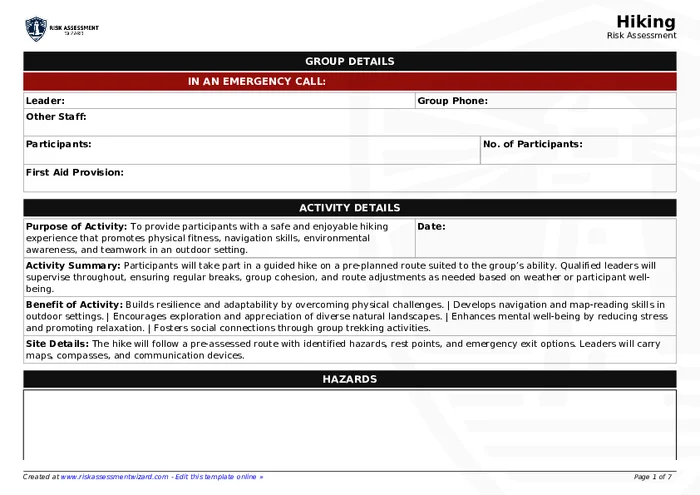
Activity Summary
Participants will take part in a guided hike on a pre-planned route suited to the group’s ability. Qualified leaders will supervise throughout, ensuring regular breaks, group cohesion, and route adjustments as needed based on weather or participant well-being.
Purpose of Activity
To provide participants with a safe and enjoyable hiking experience that promotes physical fitness, navigation skills, environmental awareness, and teamwork in an outdoor setting.
Benefits of Activity
- Builds resilience and adaptability by overcoming physical challenges.
- Develops navigation and map-reading skills in outdoor settings.
- Encourages exploration and appreciation of diverse natural landscapes.
- Enhances mental well-being by reducing stress and promoting relaxation.
- Fosters social connections through group trekking activities.
- Enhances communication and group management.
- Builds resilience and adaptability while developing the skills to manage personal safety in varied cold and wet environments.
- Develops respect for agricultural environments.
- Builds self-care and preparedness skills.
- Teaches navigation and group coordination skills.
- Encourages environmental awareness.
- Promotes endurance, self-awareness, and the ability to manage personal energy and health in challenging outdoor conditions.
- Enhances communication and group management.
- Builds spatial awareness.
- Teaches essential life-saving skills.
- Ensures safety through effective monitoring and guidance.
- Teaches the importance of ergonomics and load management.
- Promotes health and hygiene.
- Promotes safe and knowledgeable guidance for all participants.
- Encourages inclusion and equal opportunity for participation.
- Strengthens leadership skills and promotes group cohesion.
- Teaches essential road safety and awareness.
- Promotes a safe and secure environment for all participants.
- Promotes medical preparedness and response.
- Builds awareness and adaptability in variable terrains.
- Develops careful planning and focus in natural settings.
- Teaches personal health checks and hygiene in nature.
- Builds teamwork, decision-making, and water safety awareness while promoting careful risk assessment in outdoor environments.
Hazards and Control Measures
| Hazard | Control Measures |
|---|---|
| Getting separated from the group | Always maintain a headcount, use a buddy system, and designate a “sweeper” at the back to ensure no one falls behind. Regularly regroup at key points. |
| Adverse or extreme weather conditions | Check detailed weather forecasts and monitor conditions prior to and throughout the hike. Adapt routes and schedules to avoid hazardous conditions such as storms, high winds, or extreme heat. Ensure participants have appropriate layered, waterproof, and breathable clothing, sun protection, and sufficient water. Schedule hydration and shade breaks in hot weather and warming breaks in cold conditions. Carry emergency shelter, thermal blankets, and first aid equipment. Avoid exposed ridges, open areas, and flood-prone zones during storms, and have clear contingency plans for shelter or early route termination. |
| Aggressive encounters with livestock | Educate participants on how to safely pass through fields with livestock, including not startling animals or getting too close to young or territorial animals. |
| Blisters from poor footwear | Ensure participants wear properly fitting, broken-in boots. Encourage the use of moisture-wicking socks and blister prevention methods, like taping sensitive areas. |
| Disorientation in fog | Use compasses, GPS, and markers when hiking in foggy conditions. Teach participants to stay close and not wander off trails in limited visibility. |
| Falling branches | Avoid hiking under trees during high winds. Always be aware of the condition of the trail and overhead hazards. |
| Fatigue, overexertion, and altitude effects | Plan routes suited to the group’s fitness and experience. Pace the hike appropriately and take regular rest breaks. Encourage adequate hydration and nutrition before and during the hike. At higher altitudes, allow time for acclimatisation, plan slower ascents, and monitor participants for early signs of altitude sickness. Adjust pace or route if participants show signs of fatigue or distress. |
| Getting separated from the group | Always maintain a headcount, use a buddy system, and designate a “sweeper” at the back to ensure no one falls behind. Regularly regroup at key points. |
| Low branches | Instruct participants to stay alert to overhanging branches, particularly in dense wooded areas. Clear branches from the path when possible. |
| Inadequate first aid response | Ensure leaders are trained in first aid, and carry a fully stocked first aid kit. Encourage participants to learn basic first aid skills relevant to outdoor activities. |
| Inadequate supervision | Maintain a suitable ratio of leaders to participants, considering the group's age and the hike's difficulty. Supervisors must be spread throughout the group, with leaders at the front, middle, and back. |
| Injury from carrying heavy backpacks | Teach proper backpack packing techniques and ensure packs are fitted correctly with weight distributed evenly. Limit pack weight to 15-20% of body weight for young hikers. |
| Insect bites (e.g., mosquitoes, flies) | Use insect repellent and wear long clothing. Educate participants on the importance of avoiding stagnant water where insects are common. |
| Instructor qualification/experience | Ensure instructors have relevant outdoor leadership qualifications (e.g., Mountain Leader or equivalent). They must be trained in first aid and have experience in managing youth groups in outdoor settings. |
| Participants with additional needs | Assess and accommodate individual needs through tailored support plans. Include extra staff or specialized equipment where necessary, and ensure everyone is briefed on the requirements of any participant with additional needs. |
| Poor group management | Assign roles to group leaders and ensure clear communication channels between leaders and participants. Use regular headcounts and regroup at key waypoints to avoid fragmentation. |
| Road crossings | Always cross roads as a group at designated points. Instruct participants on road safety, particularly in areas where traffic may not expect pedestrians. |
| Safeguarding | Ensure all participants are aware of safeguarding policies. All adult supervisors should be DBS-checked (or equivalent), and leaders must maintain vigilance in identifying and reporting any issues or concerns related to participant safety. |
| Severe allergic reactions (e.g., bee stings) | Ensure participants carry necessary allergy medication, such as epinephrine, if needed. Brief everyone on how to identify and respond to severe allergic reactions. |
| Slips on wet ground | Ensure participants wear appropriate hiking boots with good grip. Encourage walking in single file on narrow paths, and remind participants to be cautious when moving through muddy or wet sections. Instruct them on proper balance techniques. |
| Uneven terrain | Teach participants to watch their footing on rocky or uneven trails. Use hiking poles for additional balance. Ensure regular breaks to reduce fatigue, which can contribute to stumbling. |
| Tick bites | Encourage wearing long clothing and using insect repellent. Teach participants to check for ticks after the hike, especially in areas of high grass or dense foliage. |
| Water crossings and immersion risks | Choose safe crossing points with stable footing or shallow water. Use ropes, walking poles, or linked arms for stability, and assist less confident or younger participants. Avoid unnecessary water exposure, particularly in cold or fast-moving water. Keep participants back from unstable or slippery riverbanks, and have dry clothing and emergency thermal blankets available in case of immersion. |
Related Risk Assessment Template Downloads
- Beach Visit (Non-Swimming)
- Bonfire/Firework Display
- Camping Trip
- Cycling Off Road
- Hiking
- Kayaking on a Lake
FAQ
How do I use this template?
Click “Edit Using Wizard” to customise the assessment for your organization, then download a PDF.
Can I edit the hazards and controls?
Yes, all sections can be adjusted in the wizard before exporting your final document.
