

Beach Visit (Non-Swimming) - Free Risk Assessment Template PDF
This free Beach Visit (Non-Swimming) risk assessment template is designed for youth group settings. It outlines typical hazards and suggests control measures, helping you tailor the document to your organization. Use it as a starting point, customise in our online wizard and download a professional PDF in moments.
Activity Summary
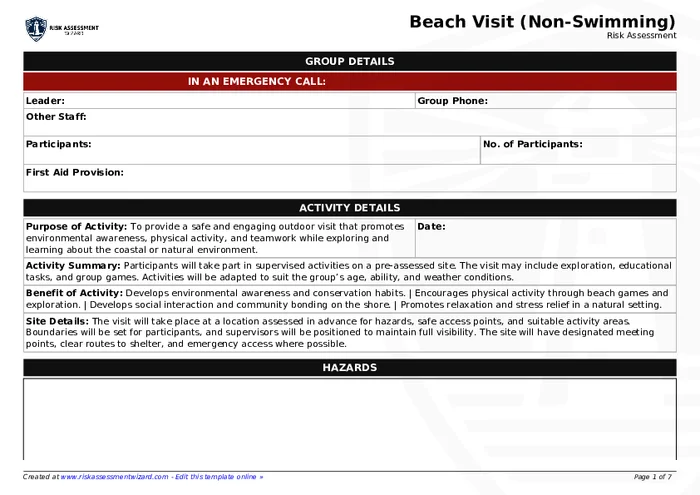
Participants will take part in supervised activities on a pre-assessed site. The visit may include exploration, educational tasks, and group games. Activities will be adapted to suit the group’s age, ability, and weather conditions.
Purpose of Activity
To provide a safe and engaging outdoor visit that promotes environmental awareness, physical activity, and teamwork while exploring and learning about the coastal or natural environment.
Benefits of Activity
- Develops environmental awareness and conservation habits.
- Encourages physical activity through beach games and exploration.
- Develops social interaction and community bonding on the shore.
- Promotes relaxation and stress relief in a natural setting.
- Builds adaptability and resilience, and develops the skills to prepare for and operate safely in a variety of environmental conditions.
- Encourages respect for wildlife, promotes animal safety practices, and develops awareness of potential risks in natural environments.
- Promotes environmental stewardship and awareness of water health.
- Ensures a safe response to any accidents or injuries.
- Instills responsibility in managing personal safety.
- Teaches the importance of proper preparation for outdoor activities.
- Promotes shared responsibility and accountability.
- Builds awareness of natural outdoor hazards, promotes preparedness, and develops the skills to respond calmly and effectively to insect-related incidents.
- Encourages learning about local ecosystems and conditions.
- Fosters responsibility for personal items.
- Helps participants engage in safe, manageable social environments.
- Develops independence, situational awareness, and group responsibility while reinforcing the importance of staying safe and accountable in public spaces.
- Fosters inclusivity and awareness of diverse needs.
- Enhances understanding of tidal ecosystems and safety protocols.
- Promotes environmental awareness and respect for natural coastal features while teaching safe behaviour around potentially hazardous landscapes.
Hazards and Control Measures
| Hazard | Control Measures |
|---|---|
| Adverse or extreme weather conditions | Monitor weather forecasts before and during the visit. Ensure participants have suitable layered, waterproof, or breathable clothing, sun protection, and adequate water. Schedule hydration and shade breaks in hot weather, and provide warm drinks or shelter in cold or wet conditions. Avoid exposed or flood-prone areas in storms, and have a contingency plan to postpone, adapt, or end the activity if conditions become unsafe. |
| Animal encounters (land & marine) | Brief participants on appropriate behaviour around animals, including maintaining a safe distance, not feeding or provoking them, and remaining calm if approached. Instruct participants to avoid handling or approaching marine life such as jellyfish or sea urchins. Supervisors should monitor the area for potential hazards and intervene if necessary. Carry a first aid kit for treating bites, stings, or related injuries. |
| Contaminated water (e.g., polluted seaweed or debris) | Inform participants not to touch or step into water with visible debris or pollutants. Perform a site assessment before arrival and steer the group away from contaminated zones. Use signage to demarcate unsafe areas and provide hygiene facilities for washing after the activity. |
| First aid provision | Ensure a trained first aider is present and carries a fully stocked first aid kit, including materials for treating cuts, stings, and other injuries. Know the location of the nearest medical facility, and have emergency contact numbers readily available. |
| Hazardous debris | Conduct a visual sweep of the area before allowing participants access. Ensure everyone keeps their shoes on in high risk areas and avoids touching objects. Carry grabbers and gloves if collecting debris is part of the activity. First aid kits should be readily available to treat injuries. |
| Inadequate clothing | Brief participants and parents ahead of time on the required clothing for the trip, considering weather and terrain. Ensure spare clothing and protective gear (e.g., waterproofs, hats, gloves) are available in case of unforeseen weather changes or participants arriving unprepared. |
| Inadequate supervision | Ensure adequate adult-to-child ratios, based on group size and specific needs. Assign supervisors specific roles (e.g., first aid, crowd control). Rotate supervision roles to maintain focus and avoid fatigue. All supervisors should be briefed on the activity plan and safety protocols. |
| Insect bites and allergic reactions | Gather medical information from participants in advance to identify allergies. Carry necessary medication, such as antihistamines or EpiPens, and ensure at least one supervisor is trained to administer them. Provide insect repellent and advise wearing long sleeves and trousers. Monitor the area for nests or swarms and instruct participants to avoid these locations. |
| Lack of local knowledge | Conduct a site visit before the activity to become familiar with the area. Contact local authorities, such as coastguards or park rangers, for insights into specific risks. Provide supervisors with detailed maps and emergency contact information for the location. |
| Lost personal belongings | Advise participants to only bring essential items and provide a secure, supervised location for belongings. Label personal items with the participant's name, and remind the group to check their area for belongings before moving to another location or ending the trip. |
| Overcrowding of public beach | Schedule the visit during off-peak hours to avoid large crowds. If the beach becomes overcrowded, move the group to a quieter, less populated area. Ensure participants are clearly identifiable with wristbands or colored shirts, and perform regular headcounts to prevent anyone from getting lost. |
| Participant separation and poor group control | Establish clear group boundaries and communicate them to all participants. Use a buddy system and conduct regular headcounts. Split the group into smaller, manageable teams with a designated leader when appropriate. Ensure supervisors are spread out to maintain full visibility and maintain radio or phone contact. Provide clear instructions on what to do if separated, including a meeting point and audible signal like a whistle. |
| Participants with additional needs | Ensure that all participants' medical, physical, and learning needs are identified and catered to in advance. Provide appropriate support staff where needed, and adjust activities to be inclusive for all participants. Carry necessary medical supplies or assistive devices for participants with specific conditions. |
| Tidal changes | Consult tide charts before the visit and schedule the event during low tide. Mark safe boundaries and instruct participants not to enter the water. Supervisors should be stationed near the water to ensure no one ventures too close to rising tides. |
| Unstable geological features (cliffs, dunes, falling rocks) | Conduct a pre-visit inspection to identify and mark off unstable areas such as cliffs, dunes, or rocky outcrops. Instruct participants to stay well clear of these zones. Use signage or physical barriers if needed. Position supervisors strategically near hazard zones to monitor behaviour and intervene promptly if boundaries are approached. |
Related Risk Assessment Template Downloads
- Beach Visit (Non-Swimming)
- Bonfire/Firework Display
- Camping Trip
- Cycling Off Road
- Hiking
- Kayaking on a Lake
FAQ
How do I use this template?
Click “Edit Using Wizard” to customise the assessment for your organization, then download a PDF.
Can I edit the hazards and controls?
Yes, all sections can be adjusted in the wizard before exporting your final document.
